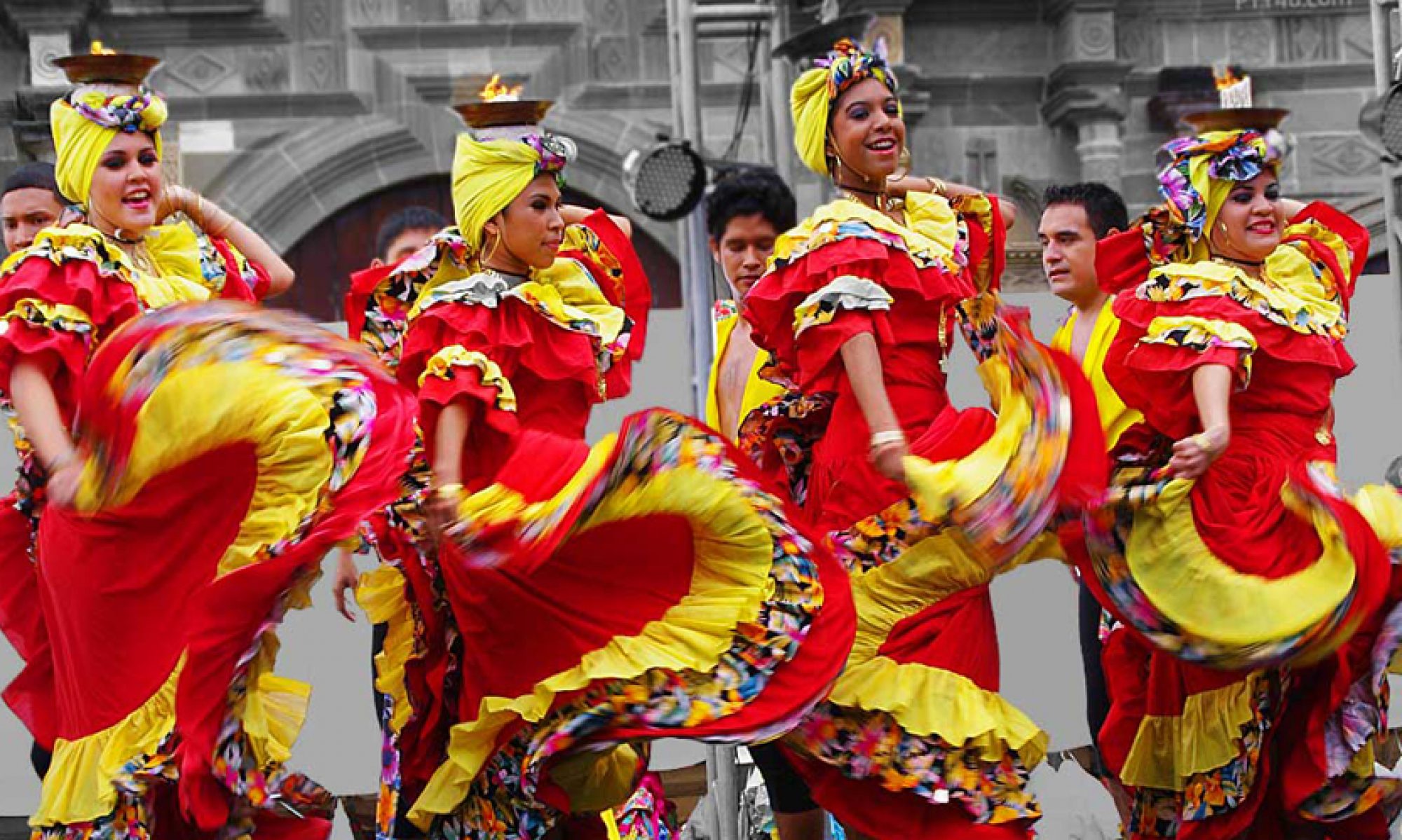
Salsa Cubana:
Salsa music today is a popular form of dance that emerged from Cuban folk culture. It has strong Afro-Cuban roots, similar to styles like son, mambo and cha-cha-cha. Like many styles of Latin dance, it saw its strong breakout period around the 1970’s in New York thanks to the city’s strong Latin heritage. As New York City is considered a cultural melting pot, different cultures added various flavors to salsa music and dance. Different styles of salsa can be found with Cuban, Puerto Rican, Colombian, and New York interpretations. Salsa is commonly danced in nightclubs, ballrooms, studios, restaurants, and outside for special events or just courtyard gatherings.
Dancing to salsa music involves a couple with one lead and one follower, gendered typically by a male and female respectively. Movements are coordinated with the rhythm of music typically in an octatonic (eight-count) beat. Shifting weight with each step creates a natural body flow which comes from moving forward and backward, and side-to-side with the hips and hands, while the upper body follows feet. Different music can be danced at beats as low as 150 bpm (beats per minute) or up to 250 bpm for a very fast-paced dance. In most movements, three steps are counted forwards, one for orientation, three steps back, one more for reorientation, and the cycle continues.
While salsa was popularized in the 1970’s it had arrived in the United States around the 1940’s. However, when Fidel Castro took power, political tensions rose and the influence was interrupted. The roots of salsa come from eastern cities in Cuba such as Santiago and Guantanamo where Afro-Cuban elements combined to bring dance to the people.
Stepping Out Studios:
As perhaps the most popular and well-known style of Caribbean dance, we had no trouble finding Salsa classes to attend and receive some hands-on experience with the discipline. We signed up online for ‘‘Salsa Academy level 1 and 2″, a class designed to teach beginners the basic steps, combinations, turning technique, and musicality of On2 Salsa. On2 Salsa is the name given to the style of Salsa dance that developed as Mambo dance became popularized in New York.
We traveled down to Stepping Out Studios in the FlatIron district for our 6:30pm class. Diane Lacktrupp founded the studio in 1985, which filled a gap in New York dance studios that was left empty when USA Champion dancer Bill Davis closed the doors of his studio. Bill handed his connections to Diane to help her efforts in opening a new studio, allowing this studio to grow over the years into what we see today. Stepping Out has had a number of owners over the years and it is now owned by a former student George Ciao, a businessman with a passion for dance. Ciao has kept the traditional visions of the studio central while adding and growing in tune with the rest of the dancing world. The studio’s website attributes much of its recent success to the Ciao’s support.
Ciao’s hard work to keep the studio thriving was apparent from our visit as we observed the fantastic facilities, well-organized and popular classes, and a welcoming atmosphere. We arrived early, and while waiting in the lobby, we could see the studio’s most advanced group practicing. It was a true insight into salsa dancing at the very highest level with rigorous drilling and complete attention to detail.
Nelson Flores, the instructor of class, has had fifteen years of experience teaching Latin Dance music. He owns his own dance studio in the Bronx where he teaches students of all ages. To start the class, Nelson arranged our group of twenty into two lines. Standing front and center, Nelson proceeded to teach the four most basic steps that make up On2 Salsa. These steps are basic step, basic side step, Suzie Q, and the right turn instep. To learn these steps, the class followed Nelson’s lead, matching his foot movements and timing. The video linked below displays us performing some of the steps we learned.
Next, Nelson worked with us on our listening skills and rhythm work. This involved listening to the rhythm being played and clapping on a particular beat as directed by Nelson. This was difficult as losing count of the beats was easy. Practicing the skill highlighted the importance of being able to listen and interpret the music while dancing to ensure proper timing and correct application of the different steps.
The final part of the class saw the group break down into leaders (typically male) and followers (typically female). We were then partnered up and formed a large circle with Nelson and his partner in the center. From there we were taught the correct way to hold your partner, before slowly building up the basic steps we had been taught at the beginning of class. Now in partners, we were also taught the various spins that can be performed as a couple (also displayed in the video linked). Toward the end of the class, Nelson added music and we were able to consolidate all that we had learned. We performed the full repertoire of steps and spins, with Nelson directing us to switch partners every minute. Having learned so much in only an hour, it was hard to perfect the movements the first few times but after a while, we both got the hang of it.
The experience was certainly an insight into the true charisma of the Latin dance community in New York City. Even our brief experience gave us a sense of the energy and vibrancy that the discipline brings to all who participate. After spending the semester learning about the history of the music, it was enjoyable to see what Latin music culture in New York City looks like today.
Alvin Ailey Studio
The following afternoon, with our previous day’s knowledge fresh in our heads, we ventured to our next salsa retreat. A bit closer to campus, Midtown’s Alvin Ailey Studio hosts a “New York Salsa 101” that typically lasts about ninety minutes and is strictly for beginners only. Luckily for us, our knowledge of salsa dancing was certainly still in the beginning stage so we felt right at home.
While we may not have became masters of introductory salsa, we did learn from some of our mistakes. We decided to leave our running shoes at home, since they provided too much grip on the shiny wood floors; we opted for dress shoes that gave us more ability to slide and move our feet with more agility and less rubber squeaking. Additionally, we wore short sleeve shirts that were a bit more comfortable. Introductory salsa the day prior had left us a bit sweaty, as we tried to stay in time with our instructor and partner.
Arriving in Midtown, we found a similar setup to “Stepping Out Studios.” We were greeted with smiles and our lost faces let everyone know we were undoubtedly visiting for the 101 course. We were ushered towards a nice studio room, and along the way, we had an opportunity to see an open room where 20-30 people were free dancing to various styles. The studio, similarly to “Stepping Out Studios”, hosted some incredibly talented and dedicated dancers, who danced in different styles including salsa, bachata, and rumba.
Once we arrived in our smaller studio, we found our classmates and instructor preparing. Gabriel Garcia had a smile on his face and introduced himself to the twelve novices in the class. While speaking with us, he multitasked on his phone, selecting the music to we would soon be dancing. Once the clock hit 6:30pm, it was time to begin, and without missing a beat, Gabriel called us to order.
Slightly different than with Nelson, Gabriel began the class with each of us introducing ourselves before he provided us with some background on himself. Gabriel grew up in the Bronx to Puerto Rican parents and has danced to Latin music for as long as he can remember. We learned that his passion for dance came from his grandmother, who took a large role in raising him while he was growing up, sharing her love for dance with him.
After introductions, we again deviated from Nelson’s style of teaching when we took some time to discuss what we would learn in the “New York Salsa 101” class, albeit the moves were the same. Contrasting the two classes and speaking about the dynamics of the beginner steps was much more helpful than simply jumping right into practicing them. We spent the first half of the class following our instructor, while we did what we could to minimize running into each other. The music felt slowed down, almost as if Gabriel had reduced the tempo of the songs by manipulating his soundboard.
We followed his instructions until he said it was time to pair up, and we practiced our basic, sidestep, Suzie Q, and right turn. With a bit of knowledge from the previous day, we felt significantly more comfortable, but certainly still novice. We switched pairs every few minutes, and Gabriel came around to guide us as we improved our skills. The environment was light-hearted with Gabriel making jokes to keep us engaged and good spirited. The class covered the same fundamentals of salsa as our previous lesson and it left us with just enough confidence to consider an intermediate course.
-George and Lorenzo
Bibliography
Manuel, Peter, and Michael D. Largey. Caribbean Currents Caribbean Music from Rumba to Reggae. Philadelphia: Temple University Press, 2016.
 Caribbean Dancing