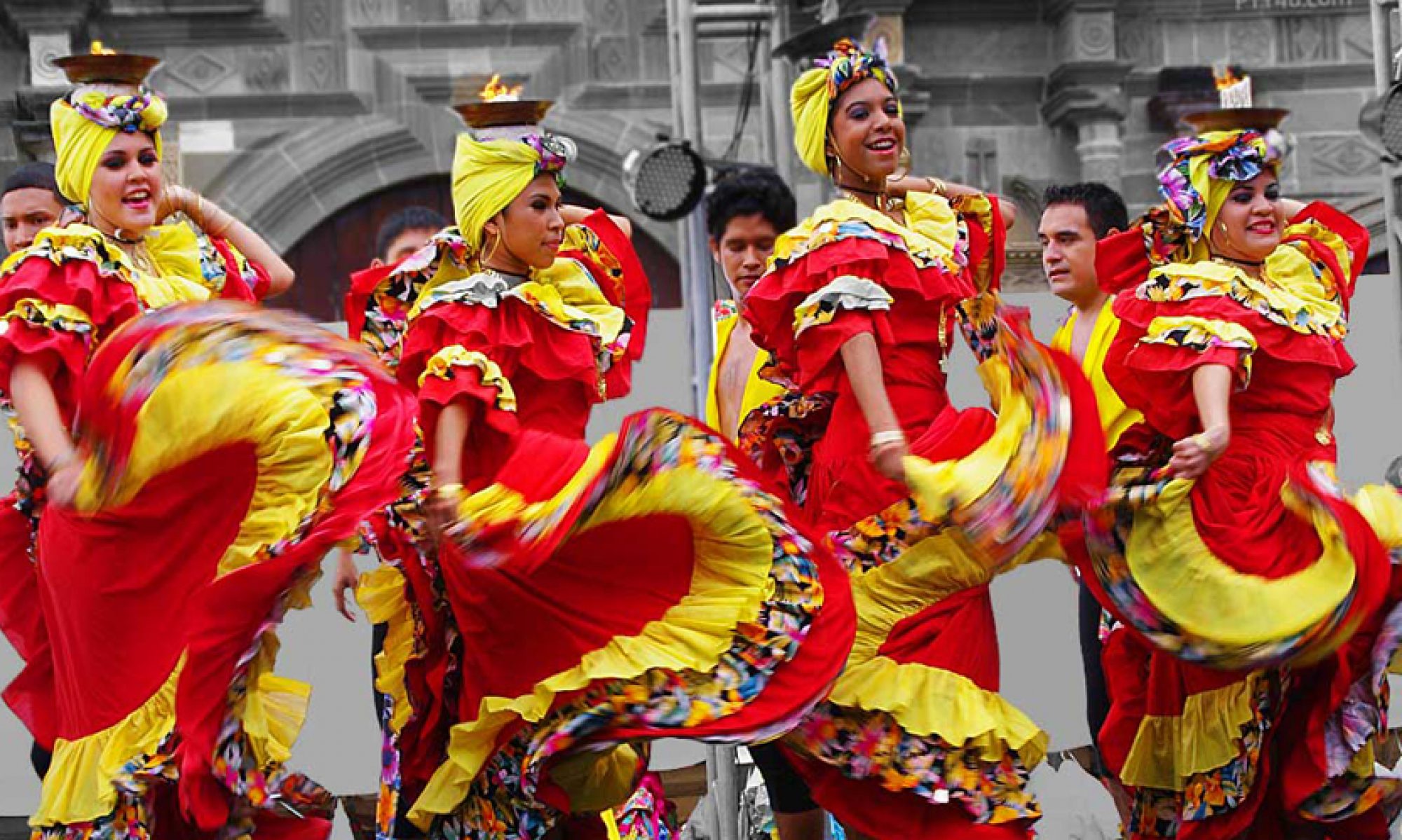
Rumba’s Form and History
The dance and musical styles of Rumba originated in Cuba after slavery was abolished in 1886. Rumba was originally meant to be party music and represent the freedom of the Afro-Cuban people. This huge cultural shift also led to a shift in the population density of the island as many freed slaves moved into more rural areas. It was in these new, poor, urban environments that Rumba really emerged. Rumba music has many features that are common among Afro-Cuban music. For example, Rumba uses the same instrumentation as Abakua and Santeria with the use of the conga, cata, and the claves. Additionally, many of the rhythms of Rumba and other Afro-Cuban songs are similar, as they originated in the streets and fields and they survived slavery and colonialism.
The tripartite song form of the Rumba is also used as the basis for all Afro-Cuban music and many pop songs as well. This form consists of the diana, which is the call to the dance. This part of the song serves as the introduction and prepares everyone for the party that is Rumba. The next part of the form is the Canto or the main body of the song. This part consists of the melody and usually includes everyday language and community conversations as a way to include the slave demographic while excluding others. Lastly, the songs consist of the Coro, or chorus. This piece of the song uses the typical call and response and improvisation that we have seen so prominently in most of the music that arose from Cuba and around the Caribbean. These segments can last up to twenty minutes and allow people to switch in and out and have the communities participate. The Rumba song is the music of the people and it wants everyone there to participate.
There are two dances that are incorporated in Rumba music. The first dance includes a single male showing of his virtuosity. This usually includes the man placing a bottle of rum on the ground and dancing intricate steps around the bottle. If the man bumps into the bottle and tips it over, he must buy a bottle of rum for everyone else. In this act, the man acts as though he is physically handicapped and embodies the healing power of the drums to become a virtuosic dancer. The second form the dance is very different. In this form, also called Rumba Guaguanco, the dance is about courtship. The men represent roosters and the women represent hens; this is followed by the Vacunao, which is the thrust of the male pelvis towards the women, who can deflect the men with their skirts or hands. However, if the male is accepted, he gets a date with the woman.
Difference Between Rumba and Rhumba
Although commonly confused with one another, what has come to be known as the “Rumba” dance is not what we learned as typical “Rumba”. The dance that we learned should actually be classified as Rhumba. Rhumba arose in the United States as the spread of Latin music infiltrated the New York Streets. Son Pregon was labeled as Rhumba and became an international dance craze. This had nothing to do with the previously mentioned Rumba dance. The rhumba dance, also commonly known as ballroom Rumba, is a combination of big band music of son pregano and the conga and Rumba. Don Azpiazu and El Manisero popularized this form, gaining popularity in America and Europe and creating a craze that was the first of the Latin music crazes in the first half of the 20th century. This form was also characterized by its variable tempo.
Our Dance Experiences
Overall, our experiences at the two dance classes we attended were very similar. The first dance class that we went to was at Arthur Murray Manhattan and the second was at Piel Canela. Our experience felt like a very typical dance class. The studio was on 34th St and it catered to couples practicing for their wedding dance and competitive ballroom dancers. The studio was also set up to represent a prom night and was not what we had expected for my dance class. Our class consisted of both Rumba and Mambo split with thirty minutes of training in each dance style. Beginning with Mambo, the class split up between men and women and each group learned the initial steps. Our Mambo instructor described the dance as an off-beat salsa, with an emphasis on the even (second) beats; the emphasis on the beat was displayed through a transferring of weight from front to back. This motion helped us to get our bodies into “feeling” the music.
Halfway through the class, we transitioned into our Rumba dance. From what we had learned in class and through the readings, we had expected Rumba to be more of a single person party dance. In class we talked about how Rumba was party music that emerged in the poorer outskirts of urban environments and it was a cultural expression of freedom and the slaves’ way of life. With this in mind, we had expected the instructors to show us the typical form of Rumba that we discussed earlier, in which a single man would perform intricate steps around a bottle of rum. The focus on the men seemed important to us as in all of the music we have listened to this semester men have played the major role. The form that we practiced in our dance classes was actually more similar to the style of the Rumba guaguancó. Although this form is different than the male-focused Rumba, we were instructed to find a deeper connection with the ground due to the dance’s roots in Africa.


The form of Rumba that we learned is actually identified as the Rhumba or Ballroom Rumba, and it presented itself as a couples’ dance that used to be performed in dance halls and clubs. Unlike the waltz, the Rumba steps should be more constrained and in a smaller area. In both classes, we started out with the most basic form of the Rumba, the Rumba Box. The image to the left shows the six steps and provides a visualization of the “box”. After we learned this step we paired up with our partners and danced these steps while listening to Rumba music. The pace of the Rumba music lends itself nicely to this movement. The six steps follow the rhythm of “slow, quick, quick, slow, quick, quick”, mimicking the rhythm of the music. After learning the Rumba box, we were taught the Rumba waltz. The Rumba waltz follows the same pattern as the box, but it begins with seven steps forward in the same “slow, quick, quick, slow” rhythm, then the side steps, followed by seven steps backwards in the same rhythm and finishes with the closing of the box. This step provided more movement and excitement to the dance. Lastly, we learned the turning Rumba box. This movement follows the same basic steps as before but it requires the dancers to turn one quarter of a circle for each completed box so that by the time four boxes are finished the couple is facing the same direction as before. The Rumba dance was quickly learned and we would highly recommend that any couples who are interested in learning a fun and romantic dance sign up for the next available Rumba class.
– William and Ben
 Caribbean Dancing