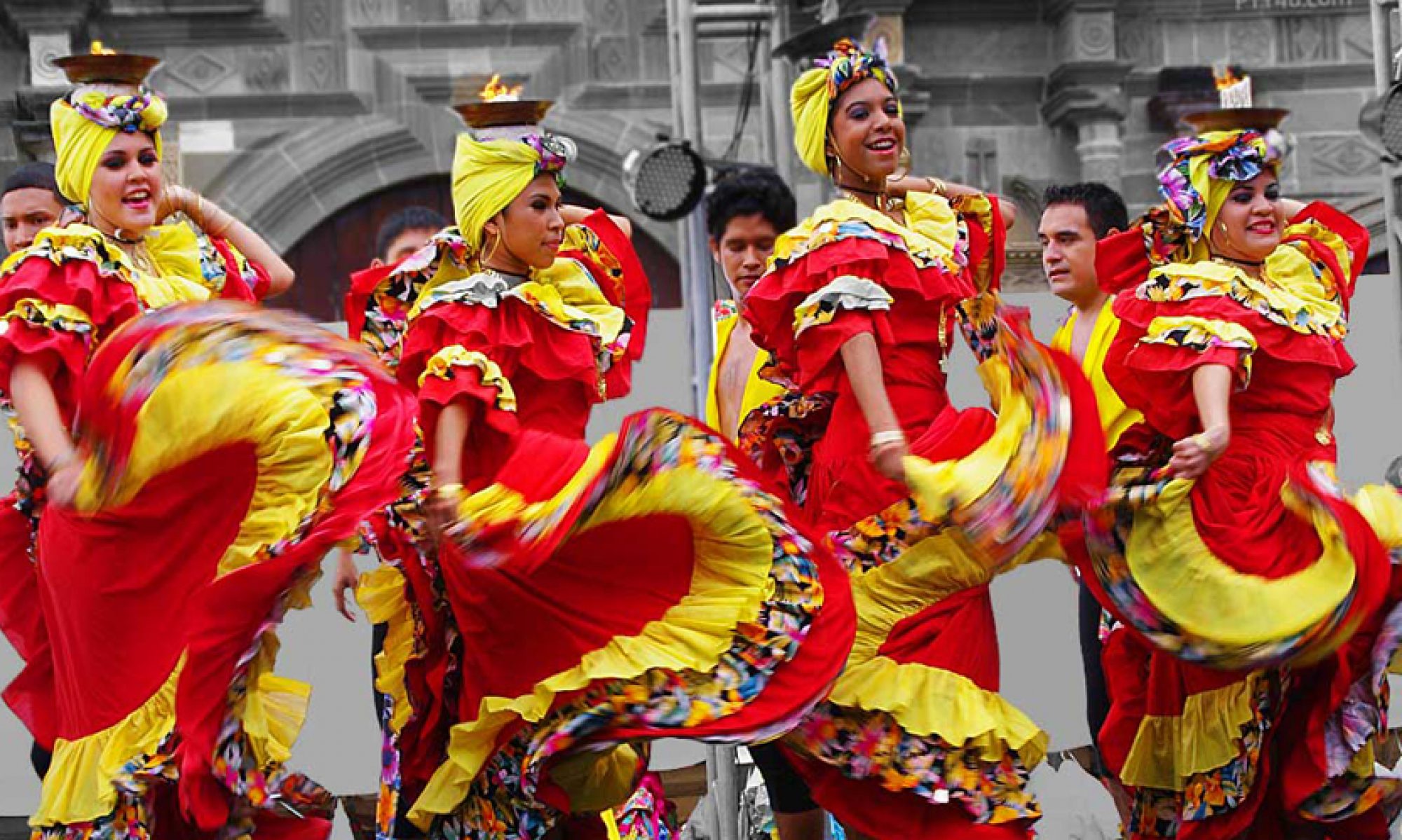
A Dance from the Dominican
“Dominicans themselves would agree that one of the salient characteristics of their culture is the universal love of music and dance. Music is considered part of their very genetic makeup: Dominicans carry their music en la sangre (in their blood)”
-Deborah Pacini Hernandez, “Bachata”
Bachata is a form of Caribbean guitar music that originated in the Dominican Republic in the mid 20th century, but didn’t achieve mainstream or international popularity until much later. First heard after the assassination of Rafael Trujillo, whose thirty year dictatorship was responsible for the bloodiest era in Dominican history, bachata was the music of la gente baja, the lower class of people. The term bachata refers to a social gathering with song and dance, but was applied to the musical genre as a term of belittlement. It gained traction in some of the poorest areas of the Dominican as farmers moved to Santo Domingo after Trujillo’s fall, and ended up in rundown shanty-towns.
Also referred to as música de amargue (bitter or blues music), bachata draws influence from the Cuban bolero and son. The main guitar drives the rhythm, accompanied by a second guitar creating syncopation as well as bongos and maracas as percussion. Its simple rhythms, and relatively rudimentary musical techniques, meant that bachata was not accepted by the middle or upper classes, which preferred the orchestral complexity of big-band merengue instead. Despite rapidly expanding popularity amongst the poor, bachata wasn’t accepted at popular venues, national radio stations, or television networks. Bachateros never earned royalties on tracks that were able to make it to air, and instead they earned their income from live performances alone. The importance of the live performance to the bachatero’s livelihood helped create an accompanying dance that took the same name as the genre.
“rage, depression, anguish, conflict, and knives; it smelled of sewer, of street, rum, mud—in short, it was urban music.”
-Juan Valoy on bachata in the ’80s.
Bachata didn’t earn international acclaim until the early 1990s, when Juan Luis Guerra, a successful, formally trained musician, released an album titled Bachata Rosa. While the album was comprised mostly of merengue and salsa, there were several bachatas in which Guerra matched the singing style of the original lower class farmers and laborers who created the genre. Guerra’s conventional music background lifted his bachatas to a middle class acceptability; in 1992 Bachata Rosa won a Grammy, legitimizing bachata in an international light and bringing it to international audiences, such as those in New York.
Dancing Bachata
Our instructor leads us through a bachata box step at Club Cache.
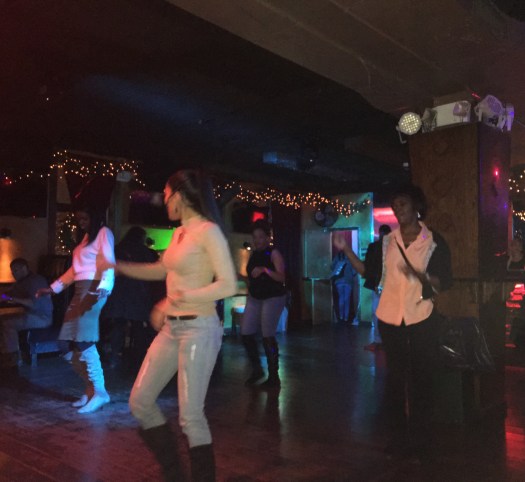
At 7pm on Tuesday, November 13, we had our first experience dancing bachata at Kana Tapas Bar in Lower Manhattan. The bar has been hosting free bachata lessons every other Tuesday for over a decade. Most of our classmates, of whom there were about fifteen, were also relatively new to the dance. We hoped that we’d be able to keep up.
Our instructor, Brian Thomas, started with the very basics, teaching us the four-beat step, which, as he explained, is the foundation of all bachata dancing. Beginning with the left foot, the dancer steps left, right, left again, and then ends with a final tap with the right foot. The right foot isn’t placed all the way down on the final step; instead the dancer taps the right toe and leads off with the right foot (instead of the left) when beginning the next four-beat step pattern. We began by just stepping in place, and despite a complete lack of dancing coordination, we were quickly able to pick up the basic timing of the steps.
The steps progressed to movements around the floor, but the four-step pattern ending in a tap was used consistently throughout the night, acting as the foundation for all of the dance moves that we learned. We took these four steps forward, backwards, left, and right, as well as in a traditional box pattern, in which we traced the outline of a square with two sets of four steps. The movements became slightly more complicated as we introduced turns and half-turns, in which we rotated 360 or 180 degrees in just four steps. As we began to master the steps, we were also instructed to try keeping our hands above our hips and looking forwards, rather than looking down at our feet.
The instructor also directed us to listen carefully to the music and distinguish the various instruments in order to time our steps to the beat of the drum. The set list included Regálame Una Noche by Kiko Rodriguez, Me Enamoro by Antony Santos, Dos Locos by Monchy & Alexandra, La Carretera by Prince Royce, and Hoy Lo Vi Pasar by Alexandra. Our instructor also pointed out that most of the songs included a lead guitar, bass guitar, güiro, bongo drum, and male vocalist, and he suggested that we focus on the drums and male vocals in order to stay on beat. Picking apart the song’s different elements while dancing gave us a new appreciation for the purpose of the different instruments, and how they combine to create a rhythmic, danceable song.
After mastering the individual movements, we formed two lines facing one another to begin pairs practice. The steps were identical to the individual patterns, but this time a partner, who rotated every minute, joined us. The leader, who is typically the male in the duo, leads the step pattern and decides where to step next. The follower, as the name suggests, follows the leader. We were taught that there are three different ways to hold your partner: the open, semi-open and closed positions. The open position is meant for first introductions, and consists of the leader putting his palms out facing up, and the follower placing her hands in his. In this position, partners are relatively far away from each other; this meant that we didn’t accidentally step on our respective partner’s toes while learning their particular dancing style. Next, we danced using semi-open position, a slight variant on the open position, with the only difference being that the leader closes his grip on the follower’s hands. Lastly, we danced using the closed position, which is the most intimate, as it involves the leader placing his right hand on the follower’s back, the follower placing her left hand on the leader’s shoulder, and the pair gripping each other’s free hand. Rotating through several different partners allowed us to see many different techniques and interpretations of the simple bachata steps; it also taught us to adjust to different partners’ dancing styles and to feel more comfortable improvising.
Ticket stubs from Club Cache
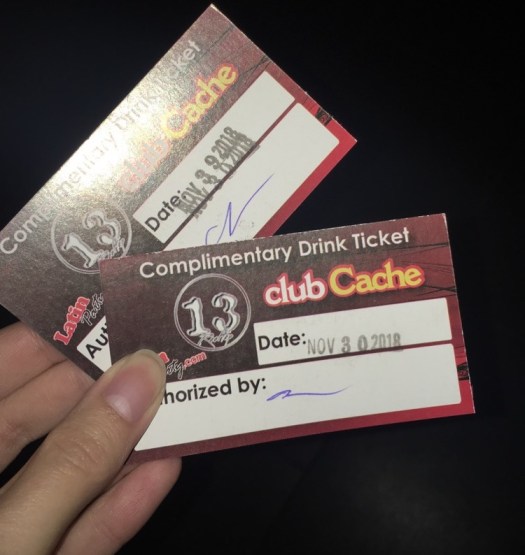
We really enjoyed the dance and company at our first bachata lesson, and we were excited for our second lesson on Friday, November 30 at Club Cache by Union Square. The lesson began at 9:30pm on the second floor of the club, and we were charged a $7 cover fee at the door. Dancing at a more central Manhattan location on a Friday evening meant that our classmates were less focused on learning bachata and more focused on enjoying a night out. We noticed that the instructor, too, was less focused on the class mastering the technical aspects of bachata, and more concerned with the class having fun. Overall, although our instructor taught us a few more step variants, the real value of the night came from being able to practice in a more casual setting. With only loose guidance from the instructor, we were able to experiment with the dancing style, learn on our own terms, and add our own flair to the movements; we had become much more comfortable with the four-beat step, and we were able to easily apply it to new moves.
In just two, hour-long lessons, we were able to transform our bachata skills from entirely non-existent to passable in a New York club. We had great instructors and we were fortunate that our first lesson was more instructional while our second lesson was more open-form and casual. Learning about bachata in the context of dance is a great way to listen to the music critically, reflect on the genre’s origins, and pick up some cool new dance moves. We had a lot of fun learning bachata in New York, and we look forward to showcasing what we’ve learned on the dance floor!
-Brooks and Sophie
Bibliography
Hernandez, Deborah Pacini. Bachata: a Social History of a Dominican Popular Music. Temple University, 1995.
Hernandez, Deborah Pacini. Oye Como Va! Hybridity and Identity in Latino Popular Music. Temple University Press, 2010.
 Caribbean Dancing